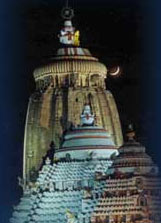
Sun Temple: The magnificent Sun Temple
at Konark is the culmination of Orissan temple architecture,
and one of the most stunning monuments of religious architecture
in the world.Built by the King Narasimhadeva in the thirteenth
century, the entire temple was designed in the shape of
a colossal chariot with seven horses and twelve wheels,
carrying the sun god, Surya, across the heavens. Surya
has been a popular deity in India since the Vedic period
.
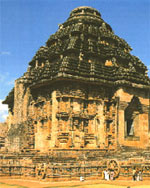
Konark is one of the well known tourist attractions
of Orissa. Konark, Konark houses a colossal temple dedicated
to the Sun God. Even in its ruined state it is a magnificient
temple reflecting the genius of the architects that
envisioned and built it. Bhubaneshwar, Konark and Puri
constitute the Golden triangle of Orissa, visited in
large numbers by pilgrims and tourists.
Konark is also known as Konaditya. The name Konark
is derived form the words Kona - Corner and Arka - Sun;
it is situated on the north eastern corner of Puri or
the Chakrakshetra. Konark is also known as Arkakshetra.
This temple built in 1278 CE by the Ganga King Narasimha
Deva is one of the grandest temples of India and was
referred to as the Black Pagoda. The ruins of this temple
were excavated in late 19th century. The tower over
the Garbagriha is missing, however the Jagmohana is
intact, and even in this state, it is awe inspiring.
Legend has it that Samba, the king of Krishna and Jambavati
entered the bathing chamber of Krishna's wifes, and
was cursed by Krishna with leprosy. It was decreed that
he would be relieved of the curse by worshipping the
sun God on the sea coast north east of Puri. Accordingly
Samba reached Konaditya Kshetra and discovered an image
of Surya seated on the lotus, worshipped him and was
relieved of his curse.
It is said that the temple was not completed as conceived
because the foundation was not strong enough to bear
the weight of the heavy dome. Local beleif has it that
it was constructed in entirety, however its magnetic
dome caused ships to crash near the seashore, and that
the dome was removed and destroyed and that the image
of the Sun God was taken to Puri.
The Temple: The Konark temple is widely known not only
for its architectural grandeur but also for the intricacy
and profusion of sculptural work. The entire temple
has been conceived as a chariot of the sun god with
24 wheels, each about 10 feet in diameter, with a set
of spokes and elaborate carvings. Seven horses drag
the temple. Two lions guard the entrance, crushing elephants.
A flight of steps lead to the main entrance.
The nata mandir in front of the Jagamohana is also
intricately carved. Around the base of the temple, and
up the walls and roof, are carvings in the erotic style.
There are images of animals, foliage, men, warriors
on horses and other interesting patterns. There are
three images of the Sun God, positioned to catch the
rays of the sun at dawn, noon and sunset.
The Melakkadambur Shiva temple, built in the form of
a chariot during the age of Kulottunga Chola I (1075-1120),
is the earliest of this kind, and is still in a well
preserved state. It is believed that this temple set
the pace for the ratha (chariot) vimana temples in India,
as a distant descendant of Kulottunga I on the female
line, and thefamous Eastern Ganga ruler Narasimha Deva,
built the Sun Temple at Konark in the form of a chariot
in the 13th century. Kulottunga Chola is also credited
with having built the Suryanaar temple near Kumbhakonam.
Temples dedicated to the Sun are not a common feature
in the Tamil speaking region of the Indian subcontinent.
|