 |
East India is a region
of India consisting of the states of West Bengal,
Bihar, Jharkhand, and Orissa. It is geographically
between North India and North-East India, and shares
many cultural and linguistic characteristics with
Bangladesh, which formed part of this region before
Partition. The Indo-Aryan languages spoken in this
region descend from the Magadhi Prakrits spoken
in the ancient kingdom of Magadha. Of these, Magadhi
and Oriya, which remain virtually unchanged for
over a thousand years, are considered the most direct
descendants.
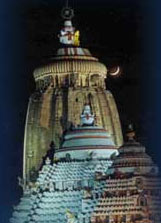
Durga and Jagannath are particularly popular deities
in this region. Puri is the eastern center for pilgrimage
in Hinduism, and Bhubaneswar is considered to be
the city of temples. |
West Bengal's capital Kolkata is the biggest metropolis
of the region. However, the cities of Bhubaneswar, Cuttack
and Puri in Orissa, and Bihar's capital Patna, were
historically more prominent. Kaali is regarded as one
of the principal deities of Bengal. There are other
temples to Kaali - Sahasrabhuja Kaali, Sarvamangala,
Tarasundari and Simhavaahini. Kaali is regarded as the
destroyer or liberator and is depicted in a fearful
form. Despite the terrifying form, she is considered
to deliver bliss to worshippers. The Kalighat temple
attracts numerous devotees throughout the year.
Kalighat is regarded as one of the 52 Shakti Peethams
of India, where the various parts of Sati's body are
said to have fallen, in the course of Shiva's Rudra
Tandava. Kalighat represents the site where the toes
of the right foot of Shakti or Sati fell. (see Daksha
Yagna).
The Kamakhya Temple in Assam The Kamakhya Temple in
Assam is one of the most venerated Shakti shrines in
India, and is regarded as one of the Shakti Peethams
associated with the legend of Shiva and Daksha Yagna.
Kamakhya is located on a hill - Neelachala Parvat or
Kamagiri near the city of Guwahati in Assam. Shakti,
residing on the Kamagiri hill is known as Kamakhya,
the granter of desires. Assam traditionally has been
known as the Kamarupa Desa and has been associated with
Tantric practices and Shakti worship.
|
