Adi Shankaracharya (7th Century) writes
about Baidyanath Temple:
" Puruwotare Gayanidhane, Sadavasantam Girija Sametam,
Surusaradhitpad Padmamam, Sri Baidyanatham TumHun Namami"
The book 'Temple of Deoghar' by Dr. Rajendra Lal Mitra
says Shiv purna dedicates these sentences.
It was in the TRETA YUGA, one demon Ravan, King of Lanka
(Ceylon) coincidently established this 'LINGAM' (Lord
Shiva). 'PADMA PURANA' (Holy book of Hindus) supports
these facts.
According to other traditions, not noticed in any purana,
the 'LINGAM' (Lord Shiva) lay neglected after the death
of Ravan until it was noticed by a rude hunter, Baiju,
who accepted it as his God and worshipped daily; proclaiming
to the world as the Lord of Baiju (Baidyanath).
Some of the purans ascribe the advent of Baidyanath
of Deoghar to the 'Satya Yug', or the first age of the
world. When Sati, the wife of SHIVA and the daughter
of DAKSHARAJA committed suicide in consequence of the
discourtesy shown to her husband by Raja Daksha; the
heart falling spot of Deoghar (Baidyanath) of SHIVA'S
Sati attends is sanctity. Hence the place had been called
'SIDDHAPEETH' .
Sir William Hunter in the annuals of rural Bengal related
the Santhal tradition of Baidyanath with Santhals but
unfortunately many historians say it has no inference.
Current Condition : There are 22 temples in the same
campus of different Gods and Goddessess among which
Lord Shiva is embraced being as supreme. Modern concepts
ascribe that the shrines are of both old and new styles.
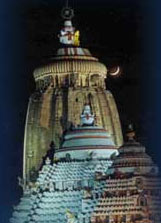
The temple of Shiva is 72 feet tall and it is lotus
Shaped. The top contains three ascending shaped gold
vessels that are compactly set, which is donated by
Giddhor King. Besides these pitcher shaped vessels,
there is a 'PUNCHSULA' (Five knives in Tridenta shape),
which is rare. In inner top there is a eight pettaled
lotus jewel (CHANDRAKANTA MANI). The 'LINGAM' (Lord
Shiva) is also very rare.
It is known as 'JYOTIRLINGAM'. In entire India these
Jyotirlingams are twelve, among those this is one. This
is described in 'ShivPurana' (Holy book of Hindus).
The greatness of this temple lies in this fact that
in this modern age the scientists are unable to open
one cross ventilated door, so it is also said that Vishwakarma
(God's Engineer) had erected this temple.
In the north of the temple there is one holy pond known
as 'SIVGANGA', regarding which there are several myths
in the society. Its present condition is brought by
king of Laxmipur state (Late Thakur Pratap Narayan Dev).
Adjacent to it there is another old pond (Mansinghi)
made during 16th century by Swami Raja Man Singh (Jaipur).
Though it's original citizens are Panari and Adivasis,
now several religious persons are residing. But priest
group is of Brahman whose deep relations is related
with the temple. But historical facts say that 'Maithil
Brahmans' came here in the end of 13th century and beginning
of 14th century from Mithila Kingdom known as Darbhanga.
Radhi Brahmans came here from Central Bengal during
16th century, Kanyakubja also came from Central India
during same phase. These all priest groups are not only
priest but they assist Shivas worshipper by giving shelter
and other help. Their unbounded contribution can be
seen in maintaining the sanctity of the temple.
The head priest is a Maithil Brahman. His post is known
as 'Sevayat' who is not only head priest but religious
administrator too. Worshippers have a very revered approach
to him. Presently the administration of the temple is
under one Trust whose members are from local panda (Priest)
community representative of king Giddhor and Deputy
Commissioner Deoghar being receiver.
Lord Shiva is not a myth for the people of Deoghar,
rather it's a live concept. Shiva is not the only source
of living. In fact it splashes the love and Bhakti to
each and everyone. This 'JYOTIRLINGAM' is in fact related
with the cultural way of wishing people in myriad occasion.
'Har Har Mahadav' is a slogan of trust and victory.
The whole world takes boon from this God.
This religious city has kept a long chain of great
SADHAK and personalities and artists, but this entire
chain remains fake just before the name of Lord SHIVA.
Even after some bhakts cannot be forgotten. This group
contains Hindu, Muslims, Christians etc. These persons
were belonging with politics medieval feudal lords in
previous days. In one side is one Muslim family (Halim
Saheb) who provides worshipping materials for Shiva
and the next aspect is daily evening (SHRINGAR) worship
which cannot be held without the garland of prisoners
of Deoghar jail.
|