| Nestling on the eastern coast along the
blue waters of the Bay of Bengal the unique State of Orissa
offers to her guests a 'tourism capsule' containing magnificent
temples, sunny beaches, colourful wildlife, traditional
tribal culture and a rich heritage.To her credit, it has
housed the important pilgrimage center for the Hindus
- Puri, the 13th century magic carved on sand stone -
Konark, the largest brackish water lake of the continent
- Chilika, the wonder greenland of the white tigers -
Nandankanan, and many more caves, Chaityas, Stupas. temples,
forts and palaces. Statistics suggests,most of the visitors
frequent this place for Lord Jagannath and the blue bay.
While several temples have vanished or have declined
in importance, the great temple of Lord Jagannath at
Puri is still a living and vibrant temple. Over the
centuries it has attracted kings, conquerers, religious
teachers, devotees and pilgrims. In the minds of the
millions of Indians, Orissa is the land of Jagannath.
This temple of Lord Jagannath ('Lord of the Universe')
at Puri is one of the most sacred pilgrimage spots in
India, one of the four abodes (dhamas) of the divine
that lie on the four directions of the compass.
The Orissan temples broadly pertain to three orders
locally known as the Rekha-deul, Pidha-deul and Khakhara-deul.
The sanctum with the curvilinear shikhara (rekha) is
called the rekha deul and the mandapa with the (jagamohana)
with a pyramadical roof of tiers(pidhas) is known as
pidha deul. In a typical Orissan temple the latter two
form the component parts of a single architectural scheme.
The later Orissan temple adds in front two more mandapas
known as the nata mandapa (dancing hall) and the bhoga
mandapa(hall of offering) in the same axis. It is however
to be noted that in the earliest group of Orissan temples
the Pidha deul is wanting and the mandapa is a rectangular
pillared hall covered by a low flat roof of two sloping
tiers with a clerestory in between. Temples of the third
order viz Khakhara deul are are only six being known
from Bhubaneshwar. An oblong plan and a wagon–vault
roof, characterize them.
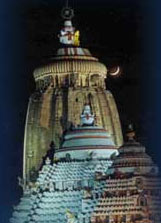
The temple of Jagannath Puri is a rekha deul with curvilinear
tower on a pancha ratha plan and was built by Ananta
Barma Chodaganga Dev during 12th century A.D. and was
completed by Ananga Bhima Dev. This temple is one of
the tallest monuments in the country, height is about
214 feet from the ground level. It stands on an elevated
platform of stone measuring about 10 acres, which is
located in the heart of the down town and presents an
imposing sight. The temple is bounded by two enclosures.
The inner enclosure is 400' x 278' and is known as kurma
bedha. The outer enclosure is of 665' x 644' with the
height varying from 20'to 24' is popularly known as
Meghanad Prachir. The temple has four gates at the eastern,
southern, western northern midpoints of the Meghanad
Prachir and are called Lions gate, Horse Gate, Tiger
Gate and the Elephant Gate respectively. The temple
has got four halls in a row such as Viman (main temple
where Lord Jagannath is worshipped with brother Balabhadra,
sister Subhadra and Sudarshan, Jagamohan (Audience hall
), Natamandap (Dance hall ) and the Bhoga Mandapa (offering
hall ).
There are festivals celebrated at the temple all throughout
the year.
Chandan yatra - chaitra Masarambha
Sneha yatra - Jyestha Paurnima
Rath yatra - shravan shukla
Jhulan yatra
Dashami to chaturdashi
Karkat or dakshinayana sankranti
Chitalagi amabashya - Shravana
Rahurekha lagi - Bhadraba
Krishnana janma
Saptapuri amabashya - Bhadraba
Ganesh chaturthi - Bhadraba
Rishi Panchami - Bhadraba 5th day
Radhastami - Bhadraba - 8th day
Parswava Parivartan - bhadraba 11th day
Bamam janma or sunia - bhadraba - 12th day
Anant chaturdashi - 1st sep bhadraba,14th day
Indra govinda puja - 2nd sep bhadraba full moon day
Sahasra kumbha mela - ashwina 8th day
Dasahara - ashwina
Kumar purnima - ashwina
|