The Vijayanagar Empire caused a number
of monuments to be built and patronized in the State
of Andhra Pradesh. The ornate Lepakshi temples being
one of the popular temples of that era. Lepakshi is
a small village, which lies nine miles east of Hindupur
in Anantapur District of Andhra and is famous for its
temple of Veerabhadra, and is also a renowned place
where the best specimens of the mural paintings of the
Vijayanagar kings are available.
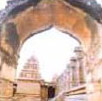
Architecture
The flat stuccoed granite ceilings of the Vijayanagar
Empire provided a suitable background for frescoes as
seen at Lepakshi. This temple is a notable example of
the Vijayanagar style of architecture, and is built
on a low rocky hill, which is called Kurmasaila so called
because the bill is like a tortoise, in shape. An inscription
on the exit of the outer wall of the temple records
that one Virupanna constructed it in the 16th century.
The beautiful sculptures on the prakaram attract the
pilgrims' attention. These include 14 forms of Siva,
like Dakshinamurthi, Ardhanareeswara, Tripurantaka etc.
The hall of creepers is another excellent work of art,
which has provided perennial inspiration to textile
designers over the years. About 500m, North-East of
the temple stands India's largest monolithic Nandhi,
measuring about 8.25m long and 4,60m high.
Lepakshi is both a tourist place worth a visit as well
as a pilgrimage centre in South India. It is centrally
located between Hindupur and Kodikonda check post. The
Andhra Pradesh State Road Transport Corporation has
its services daily from Hindupur. For lodging, there
is a R & B guest house at Hindupur and the tourists
can stay at APTD rest house as well have their lunch.
During the month of February (Asvayujamasam) the temple
authorities conduct a 10 day long celebration including
the car festival. During the festivals, Lepakshi is
packed with pilgrims from all over the country.
Thousand Pillar Temple
4-km from Hanumakonda crossroad in Warangal district
is the Thousand Pillar Temple, a fine specimen of 'Kakatiya'
architecture and sculpture. It is the main attraction
of Hanamkonda. The temple was built by 'Rudra Devi'
in 1163 AD.
The temple is in shape of a star and has three shrines
dedicated to Lord Shiva, Vishnu and Surya. The temple
is built on a 1m high platform on the slopes of the
Hanumakonda hill, and has a majestic monolithic Nandi.
The black basalt Nandi, a monolith, has a lovely polished
finish.
There are many small lingam shrines surrounding the
gardens. The temple is famous for its richly carved
pillars, screens and detailed sculpture. The atmosphere
is calm and serene with the sonorous ringing of the
puja bells, gentle chirping of the birds and the soothing
cool breeze.
|
