This image of Ganesha is bound to be familiar to anyone
of Tamil origin; however, little is known to many about
the fact that this is an image of the rock cut Karpaka
Vinayakar Shrine at Pillayarpatti near Karaikkudi at
one of the oldest Cave Temples (Rock Cut) temples of
Tamilnadu. Pillayarpatti is situated between Pudukkottai
and Karaikkudi. The nearest airport is at Tiruchirappalli.
Chennai Rameswaram Express and Kamban Express travel
to these two railheads.
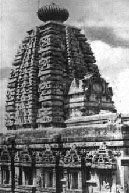 |
The town of Pillaiyarpatti is named
after 'Pillayar' - the tamil name for Ganesha, and
this ancient temple houses rock cut images of Shiva,
Lingodbhavar and others as well as several other
shrines. Steeped in the tradition of Agamic textsthe
temple bears testimony to the vibrant temple culture
of the Tamil people, passed down through centuries.
Deities: Karpaka Vinayakar or Desi Vinayaka Pillaiyar
is the presiding deity here, and he is portrayed
with two arms and a trunk curled towards his right
in the valampuri mode. This 6 feet tall mammoth
image of Ganesha is a bas relief in an excavated
cave, off of a hill in the precincts of the temple.
Tiruveesar is a Shiva Lingam carved in a similar
manner. Other deities in the temple include Marudankudi
Eesar and his consort Vaadaamalar Mangai. |
Antiquity: Over 15 inscriptions are found within the
temple, that help establish the age of the temple. The
Stalapuranam published by the temple classifies the
growth of this temple into three distinct stages.
The first stage goes back in time by about 1600 years.
During this period, the innermost rock cut shrines housing
Karpaka Vinayakar and Tiruveesar came into being. The
uniqueness of the image of Ganesha is one factor testifying
this date; the characters used in the temple inscriptions
also help establish this date. The pillars within the
shrine are of pre-Pallava origin.
The Pallavas were prolific builders of rock cut temples
(Mahabalipuram, Mahendravadi, Mamandur, Mandakapattu,
Seeyamangalam, Namakkal, Tiruchi, Nartamalai, Kudumiyanmalai,
Tirukkokarnam, Tirumeyyam, Peraiyur, Malayadipatti,
Tirukolakkudi, Kunrakkudi etc.). A number of these can
be traced to Mahendravarman I (615 - 630 AD) and Narasimhavarman
I (630 - 668 AD). However, the inscriptions at Pillayarpatti
date further back to the 4th century AD. Also, given
the location of the temple in the Pandya kingdom it
would only be logical to associate Pandya patronage
to this temple, especially in the light of Pandya patronage
at the Kazhugumalai temple not too far from here.
There are several inscriptions within this temple that
date back to the period between 1091 AD and 1238 AD,
making it apparent that the Pillayarpatti Nagarattar
became the custodians of the temple during the 13th
century AD during the second growth phase of this temple,
when Vimanams and Rajagopurams were built.
The third phase of growth is much more recent and it
involved the repair, rebuilding and refurbishment of
the entire temple complex, including the renovation
of the temple tank. The tank and the two Raja Gopurams
provide an attractive approach to the temple, in this
rather remote town of Pillayarpatti.
It is with great pride that the Pillayarpatti Nagarathar
community which has been traditionally involved with
the temple - patronizes maintenance of this temple and
the scrupulous conduct of worship services.
Worship Protocol: Each day, five worship services are
offered to the presiding deity, commencing at 6 AM ,
and closing down at 9 PM. During the fourth phase of
each lunar half month, Pillayar is taken in procession
around the temple. Hundreds of pilgrims patronize the
temple on these days.
Festivals: The grandest of festivals is Ganesh Chaturti
in the month of Aug - September, where a ten day celebration
brings much gaiety to this temple town. Each day's celebration
is marked by much splendor as Pillayar is taken in procession
around town on several of his mounts, as are the other
Pancha Murthys. The ninth day of the festival is marked
by a chariot procession. In addition, the ten day festival
in the month of Vaikasi (May - June) is held in honor
of Kongu Nachiyamman, a village deity whose processional
image is also housed here. The Margazhi Tiruvadirai
festival is celebrated in honor of Nataraja and Sivakami
(Dec - Jan).
|
