| Situated in North Karnataka, Badami
was founded by Pulakesin I in the 6th century A.D and
was once the capital of the Chalukya empire. The Chalukyas
are to be acknowledged with path-finding a new architectural
style, examples of which can be seen in Badami, Aihole,
Pattadakal and other neighboring areas. They built a
number of temples, and other monuments that marked the
beginning of the Hindu style of architecture. This new
style combined the best of two distinct styles - the
North Indian, Indo-Aryan Nagara style and the South
Indian Dravidian style. Known as the Chalukyan style,
this style is manifested in many cave temples, dedicated
to Brahmanical deities, as well as the many Buddhist
and Jain monasteries in the region.
The capital of the Early Chalukyas, Badami is picturesquely
situated at the mouth of a ravine between two rocky
hills, Badami is famous for its cave temples - all hewn
out of sand stone on the precipice of a hill.
Badami is an interesting place to visit in Karnataka
what with its artificial lake, ancient temples, Museum
and Hindu and Jain caves carved in the Sandstone hills.
The largest and most ornamental is the third cave temple
dedicated to Vishnu.
Overlooking the cave temples is a reservoir dotted
with temples dedicated to Vishnu and Shiva. Also a must
are the Bhutanath temples that lend their name to the
lake beneath the cave temples. The main attractions
of Badami are the caves found there. The caves found
here are as follows:
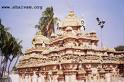
The caves found here are as follows
Cave 1 : The first cave made of red sandstone, dates
back to 578 A.D. and was probably the first to be carved.
One has to climb up 40 odd steps to reach the colonnaded
verandah, a hall with numerous pillars and a square
shaped sanctum hollowed in the control back wall.
Cave 2 : Dedicated to lord Vishnu depicted here as
a dwarf or 'Trivikrama' of awesome dimensions with one
foot mastering the Earth and the other the sky, the
second cave is atop a sandstone hill.
Cave 3 : Still going higher up one comes across this
cave antedating 578 A.D. The facade of the cave is nearly
70 feet wide, on the plinth one can see the carvings
of ganas. The sheer artistry and sculptural genius makes
this cave the highlight of Deccan art.
Cave 4 : The only Jain cave, the construction of Cave
four started in the 6th century and completed after
nearly 100 years later then the earlier three caves.
|
