According to mythology, Hindu Gods have
always had their abode in the austere, silent mountain
pinnacles. Here they have performed the severest penance
to attain omnipotence and from here have flown the sacred
rivers - 'Amrita' or life-giving water. In this area
from where all the holy rivers have taken their birth,
are the four 'Dhams' or as popularly known as in the
'Shastras' as Kedarkhand. In the remote heights ranging
from 3,050-3,584 meters (10,000 to 11,760 ft) are the
"Char Dhams" - the Yamunotri, Gangotri, Kedarnath
and Badrinath
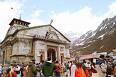
Kedarnath is amongst the holiest pilgrimages for the
devout Hindu. It is set amidst the stunning mountainscape
of the Garhwal Himalayas at the head of the Mandakini
River. Kedar is another name of lord Shiva, the protector
& the destroyer. Shiva is considered the embodiment
of all passions - love, hatred, fear, death & mysticism
which are expressed through his various forms.
Kedarnath is a majestic sight, standing in the middle
of a wide plateau surrounded by lofty snow covered peaks.
The present temple, built in the 8th century by Adi
Shankaracharya, stands adjacent to the site of an earlier
temple built by the Pandavas. The inner walls of the
assembly hall are decorated with figures of various
deities and scenes from mythology. Outside the temple
door a large statue of the Nandi Bull stands as guard.
Dedicated to Lord Shiva, the exquisitely architectured
Kedarnath temple is said to be more than a 1000 years
old. Built of extremely large, heavy and evenly cut
gray slabs of stones, it evokes wonder as to how these
heavy slabs were handled in the earlier days. The temple
has a " Garbha Griha" for worship and a Mandap
apt for assemblies of pilgrims and visitors. A conical
rock formation inside the temple is worshipped as Lord
Shiva in his Sadashiva form.
Location
Kedarnath is situated in the Uttar Kashi district of
the northern state of Uttaranchal. Very close to the
Indo-Chinese border, it is the source of the Mandakini
River. It is couched in the scenic locales of the Garhwal
Himalayas at 3583 meters above sea level. It is very
cold in the winters with the ground being covered with
snow. In the summers, the mercury barely crosses the
20°C mark. The place experiences about 150 cm of
rainfall during the monsoons and so the best time to
visit is between May and October. Kedarnath is near
to Rishikesh (234 km) and Dehradun (250 km).
History
According to legend, Lord Shiva wished to elude the
Pandavas, who had come to seek penitence for having
killed their kin in the battle of Kurukshetra. He took
refuge in Kedarnath in the form of a bull. Bhima, one
of the Pandava brothers, found Shiva amongst a herd
of cattle. Having identified the meanest and most arrogant
of the herd as Shiva, Bhima is said to have grabbed
him by the hindquarters. What remains at the shrine
in Kedarnath is the rear end of the bull, with the rest
of its body scattered throughout the Garhwal. Shiva
dived into the ground leaving behind him a hump on the
surface. This conical protrusion is worshipped as the
idol. It is the main site of the Panch Kedar temples.
|
