The oldest living city in the world,
Varanasi is the ultimate destination of all Hindu pilgrims
searching for moksha from the cycle of birth and re-birth.
The word 'Kashi' originated from the word 'Kas' which
means to shine. Kashi is mentioned repeatedly in the
scriptures - the Brahmanas, Upanishads and the Puranas.
It is the oldest center of learning and the University
here is still widely respected for its Sanskrit, Philosophy,
and Arts faculties. Hyuen Tsang, the Chinese traveler
visited Varanasi in the 7th century.
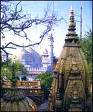
Stepped in tradition and mythological legacy, Kashi
is the 'original ground' created by Lord Shiva and Parvati.
The Kashi Vishwanath Temple is dedicated to Lord Shiva.
The temple was destroyed in the various invasions and
was rebuilt in 1776 by Rani Ahilyabai of Indore. Hundreds
and thousands of pilgrims flock to Varanasi to offer
homage and wash away their sins.
Vishweshwara jyotirlinga has a very special and unique
significance in the spiritual history of India. Deeply
and intimately implanted in the Hindu mind, the Kashi
Vishwanath Temple has been a living embodiment of our
timeless cultural traditions and highest spiritual values.
The Temple has been visited by all great saints- Adi
Shankaracharya, Ramkrishna Paramhansa, Swami Vivekanand,
Goswami Tulsidas, Maharshi Dayanand Saraswati, Gurunanak
and several other spiritual personalities.
History
The Shiva temple is believed to have been there in the
site for thousands of years, as mentioned in old scriptures.
The Mughal emperor Akbar allowed the temple to be constructed[4]
but his grandson, the harsh Islamic ruler Aurangzeb
ordered its demolition in 1669 and constructed Gaynvapi
Mosque, which still exists alongside the temple [5].
This mosque has minarets towering 71 metres above the
Ganges River and the traces of the old temple can be
seen behind the mosque. The temple spire and the dome
are plated with 1000 kg of gold donated by Maharaja
Ranjit Singh of Punjab, in 1835[6].
The temple structure
The well in the templeThe temple complex consists of
a series of smaller shrines, located in a small lane
called the Vishwanatha Galli, near the river. The linga
the main deity at the shrine is 60 cm tall and 90 cm
in circumference housed in a silver altar [2]. There
are small temples for Mahakala, Dhandapani, Avimukteshwara,
Vishnu, Vinayaka, Sanishwara, Virupaksha and Virupaksh
Gauri in the complex. There is a small well in the temple
called the Jnana Vapi (the wisdom well) and it is believed
that the Jytorlinga was hidden in the well to protect
it at the time of invasion.
Importance of the temple
The temple is widely recognized as one of the most important
places of worship in Hindu religion and most of the
leading Hindu saints, including Adi Sankaracharya, Ramakrishna
Paramhansa, Swami Vivekananda, Goswami Tulsidas, Swami
Dayananda Saraswati, Gurunanak have vitied this site
[5]. According to Hindu mythology, a visit to the temple
and a bath in the river Ganga is believed to lead one
on a path to Moksha (liberation). Thus, people from
all over the nation, try to visit the place at least
once in their lifetime. There is also a tradition that
one should give up at least one desire after a pilgrimage
the temple, and the pilgrimage would also include a
visit to the temple at Rameswaram in South India, where
people take the water samples of Ganga to perform prayer
at the temple and bring back the sand from near that
temple. Due to the immense popularity and holiness of
this temple, hundreds of temples across the nation have
been built with the same style and architecture.
|
